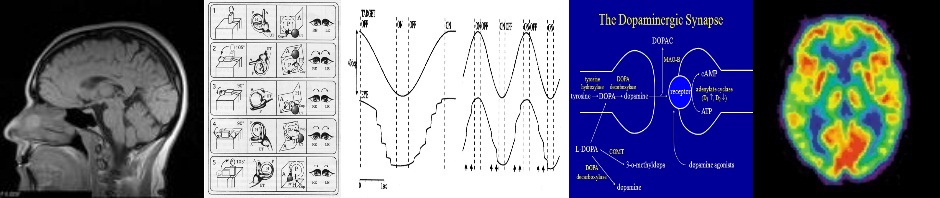
Catecholomethyltransferase (COMT) has long been known in neurobiology as an enzyme that breaks down dopamine in the synapse to prevent excessive post-synaptic stimulation and in neurology where inhibitors of the enzyme act to delay the peripheral breakdown of L-DOPA, so extending the effect of antiparkinsonian medications for an hour or two.
COMT methylates dopamine and thereby inactivates it. There has been found to be a polymorphism of COMT activity in humans without disease and this polymorphism can have cognitive effects. Older studies from the early 2000’s highlighted potential deficits of too high COMT activity in humans with the VAL158 (a valine amino acid in position 158) polymorphism because it makes the enzyme more thermostable. These effects include increased risk of psychiatric disorders such as schizophrenia and impairments on certain cognitive tasks. Broadly speaking, one could infer that a low dopaminergic state could impair reward associated performance and behaviour. Since COMT may be more critical in the prefrontal cortex than in the striatum, where there is more dopamine reuptake by dopamine transporter (DAT) as an alterative mechanism, it would not be surprising that any deficits would be cognitive and not motor (i.e. Parksonian-like).
However, we already see a wrinkle regarding schizophrenia, where traditional treatment has been with anti-dopaminergic medication, presumably worsening already low dopaminergic levels.
The alterative polymorphisms are heterozygote valine/methionine at this allele or homozygous methionine. Around 25% of Europeans are Met/Met (slow), 50% heterozygote, and 25% Val/Val (fast). In east Asian populations, Met tends to be lower.
Now there is much talk of slow COMT personality types and fast COMT types, roughly corresponding to type A and type B personalities. We have entered the realm of populist quasi-medicine.
Inevitably, there is a whole industry of what slow COMT types (because they are the ones who will obsessively read the literature) “need” to boost their COMT, ranging from avoiding “oestrogen mimickers” to avoiding coffee, tea, chocolate and red wine that “consume” COMT “resources”.
And there is a matching industry of genetic testing for finding your type and thereby, one might cynically say, achieving introspection. The genetic test costs around £150-200 to be done privately.
Finally, there is an industry of supplements, such as tyrosine (an amino acid simply present in protein food), key B vitamins (excess of B6 can give side effects), biopterin for fast COMT, and magnesium for slow COMT (a cofactor for COMT that is abundantly present in any living plant or animal cell that one might eat) because you tend to “burn through magnesium faster under stress”, presumably undergoing nuclear fusion into some other element instead of remaining as the major +2 cation in the intracellular compartment. There are also oestrogen processors that presumably reduce oestrogen levels and “stress nutrients”.
But there are a huge number of questions:
- To what extent is COMT rate limiting? There is a long pathway of dopamine and NA breakdown. Does a 3 fold reduction in activity mean anything when the rate limiting step might be elsewhere?
- COMT is not the only enzyme. What about monoamine oxidase (MAO) which performs the same function? Could there be compensatory mechanisms?
- There might be other genetic polymorphisms that interact with COMT activity or indeed MAO activity.
- Is there genetic linkage (a neighbouring gene that tends to be inherited together) with separate neighbouring genes that may have a behavioural effect. Why are slow COMT prepubertal girls taller, for example?
As mentioned above, we know of COMT from Parkinson’s disease (PD) treatment. One might expect high COMT people (not patients!) to have parkinsonian like motor or cognitive deficits, and low COMT to have excess movement and anxiety. Note however that the only clinical COMT inhibitor that acted centrally was tolcapone, which has been virtually withdrawn because of serious liver side effects. All entacapone and opicapone do is act peripherally to make orally administered L-DOPA stay in the blood stream for longer.
The purpose of this journal club is to go back to the science on the topic. To try and gain further understanding of how the polymorphism is changing the neurochemistry of the brain rather than just looking at the end result expressed as human behaviour, a transgenic mouse model of fast COMT was developed. This was specific for cortex, striatum and hippocampus COMT and not other sites like the cerebellum and outside the brain. They confirmed that the Val158 allele polymorphism had an equivalent human level 30% level of overactivity of COMT and found that the mice had deficits in stimulus response learning and working memory similar to those in human studies. They also showed signs of impulsive and compulsive behaviour. These are the kind of deficits expected to be related to dopamine signalling. They had no generalised cognitive or motor deficits, which is interesting in relation to PD.
They didn’t record reduced synaptic dopamine levels because apparently dopamine is difficult to measure in mice, but they electrically stimulated anaesthetised transgenic mice and did find increased dopamine release compared to controls, that they suggested was compensatory. One might also expect a compensatory increase in dopamine synthesis on other measures, eg increased tyrosine hydrolase (the enzyme that produces dopamine) or reduced dopamine transporter activity in the striatum (dopamine transporter clears dopamine back into presynaptic terminals to reduce the dopamine signal), but they did not find this. Strangely, the rate of dopamine decay was unchanged. So if there is no demonstrated change in dopamine activity in the synapse, what exactly are these changes compensating for? It was suggested that COMT was influencing dopamine regulation presynaptically rather than affecting breakdown of synaptic dopamine.
Given this somewhat confusing information, indicating only that there is at least one more layer of complexity to COMT, it is worth going back to more recent scientific literature to see what magnitudes of human differences are actually present between the different genotypes.
Scientific reports state that the enzyme is 25-33% less active (Tunbridge 2019) not 25% as active in methionine homozygotes. These assays are simply in peripheral blood; a functional MRI study could only measure differences in general brain activity in different genotypes while radioactive ligand PET or SPECT imaging is not looking at dopamine levels or COMT levels but again just differences in regional brain metabolism or blood flow. A DAT scan is just measuring the structural integrity of presynaptic terminals in the striatum. It takes a 90% reduction in these terminals to give clinical PD so one could not hope to see some compensatory change in DAT transporter levels from mild changes in COMT activity.
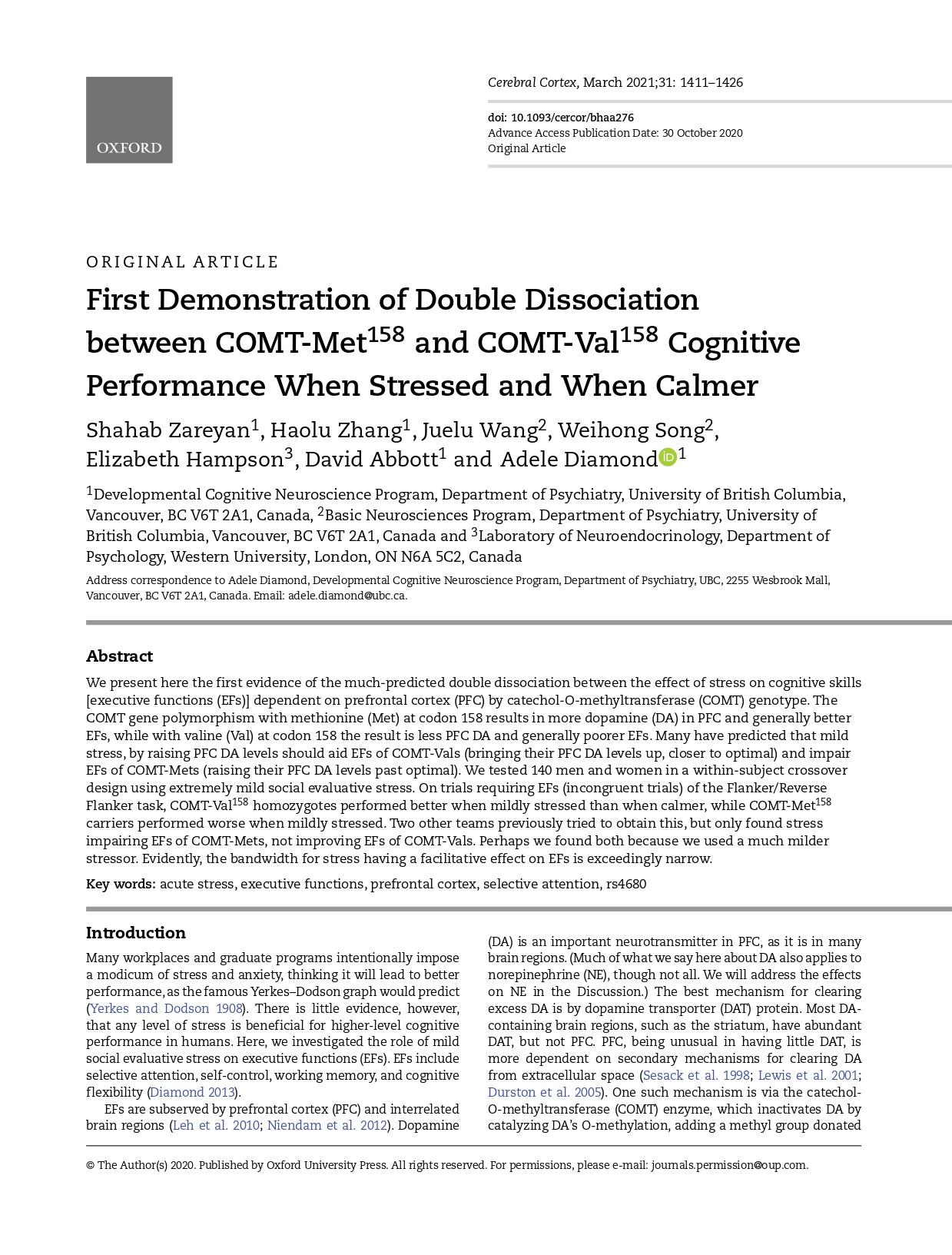
The subject of this journal club is a cognitive study by Zareyan S, Zhang H, Wang J, et al. First demonstration of double dissociation between COMT-Met158 and COMT-Val158 cognitive performance when stressed and when calmer. Cerebral Cortex. 2021;31(3):1411-1426.
I wanted to avoid yet another metanalysis and focus on individual study design. The first thing the paper clarifies is that there is relatively better executive function in Met subjects, despite the scare-mongering from the “commercial” literature as described above, and Met homozygotes are not necessarily worse. But even these findings are not universal. They sought to test a specific hypothesis, namely the prediction that the effect of stress on cognitive performance would specifically raise the performance of Val homozygotes because the stress induced extra dopamine would allow them to compensate for their background dopamine deficiency, and the performance of Met individuals would decrease under stress conditions under the same protocols.
In 140 subjects, having excluded those with pre-existing stress disorder, the stress was to have two testers in the room at the time standing behind with a clipboard. They measured salivary cortisol level to check baseline stress level and made careful efforts to make this baseline as low as possible.
The cognitive tasks included a Flanker Test, where attention is directed to a central visual stimulus on a screen and the subject is to ignore flanking stimuli. The central stimulus points left or right and the subject has to press the correct button as quickly as possible. Then the situation is reversed and the subject must ignore the central stimulus. There was also a reasoning intelligence test and a Hearts and Flowers task, where the stimulus lights up to left or right and the subject has to press the button corresponding to the opposite side.
Unfortunately, on their genetic testing, only 7% were homozygous Met met instead of expected 25% so they mainly compared homozygous Val with heterozygous Met.
The mean reaction times went from 630 ms to 600 ms under stress for Val homozygotes (ie better), and from 610 to 630 ms for Met carriers. There were similar level changes in the other measures. While significant, these differences are not exactly life-changing. From previous similar studies, the differences for Met homozygotes were not much more striking. The study confirmed that there was no speed-accuracy trade off.
The study discussed how other studies might have missed these modest effects. It might have to be exactly the right level of mild stress to make a difference ot otherwise all subjects would perform worse. Alternatively the stressor might have to be task specific or relate to a certain kind of attention demanding task. For example, in Huntington’s disease, a condition where there is severe striatal and prefrontal dysfunction in some ways opposite to those in PD, there are specific deficits with anti-saccades, an attention demanding task that has similarities with the tasks performed in this study.
The study also considered that there could be a ceiling effect where those with better baseline working capacity have less room to improve and therefore more likely to get worse with distraction or stress. They commented on the related transmitter noradrenaline (NA) and that an intermediate level of COMT activity may similarly be optimal, but that there was little evidence that COMT polymorphisms actually affected peripheral NA levels.
Overall, this seemed to be a carefully conducted study with a clear hypothesis and a clear result, despite the bad luck of not recruiting many Met homozygotes.
Turning to relevance for the general population, it is completely unclear if these measured differences have any practical meaning, enough to label someone as “deficient”, “handicapped” or “divergent”. This is very hard to justify anyway when 50% of the population is homozygote one way or the other. These are statistical effects measured across many subjects; there will be huge variations between individuals based on many other genetic and environment factors. Many more scientific studies are needed on the magnitude of these effects in practice. There are also potentially unpleasant connotations of “branding” individuals, or even worse whole populations, with a personality type based on a genetic polymorphism. Are such genetic tests going to be part of job interviews or criteria for life insurance or health insurance policies?
One potentially more helpful connotation may be sensitivity to drug side effects, specifically drugs that act on the dopaminergic and noradrenergic systems such as SSRIs, SNRIs and monoamine oxidase inhibitors in patients with or without an additional dopaminergic disease deficit. For example, might tyramine reactions be worse in slow COMT individuals because of increased lingering of dopamine and NA at the synapse. Or are the effects very complex and unpredictable as suggested by the mouse studies?
Certainly, testing for susceptibility to drug side effects is not unheard of; TPMT activity is performed routinely before giving azathioprine and one might test for certain genetic congenital myopathies before giving certain anaesthetics. What would be needed is an actual study looking at the incidence of tyramine reactions, neuroleptic malignant syndrome and other less severe drug side effects in different COMT genotypes and, if a major difference was found, genetic testing beforehand would seem to be a very valid and cost effective strategy.


 Background